Typical Installed Price Ranges
For most Baldwin County homes, a permanently installed standby generator with an automatic transfer switch lands in these ranges, fully installed (equipment, pad or stand, electrical, fuel work, and permits). They are consistent with published national figures — Generac's own cost guidance puts a professionally installed home standby system at commonly $8,000–$16,000 including the generator itself (see the 2026 Generac cost breakdown collected from manufacturer figures):
| System Size | Typical Fit | Installed Range |
|---|---|---|
| 14–18kW | Smaller homes, essential circuits plus one AC unit | $8,000–$12,000 |
| 22–26kW | Most homes: whole-house coverage including central AC | $10,000–$16,000 |
| 30kW+ | Large homes, multiple AC units, waterfront estates, shops | $16,000–$28,000+ |
Ranges are general market guidance for the Alabama Gulf Coast, not a quote. Your home's specifics — fuel, flood zone, panel, and placement — drive the real number.
Last updated: October 2026.
Size is the biggest single price lever. Estimate yours with the standby generator sizing calculator before you compare quotes.
What Moves the Price
- Fuel type: If natural gas is already at your street (much of Daphne, in-town Fairhope and Foley, and many beach neighborhoods), it's the cheapest install. Where it isn't — much of inland Baldwin — propane requires a tank; a buried 250–500 gallon tank can add roughly $2,000–$4,500 including trenching and regulators.
- Flood-zone elevation: In AE and VE flood zones in Gulf Shores, Orange Beach, and along the bays and bayous, the generator and transfer equipment typically must sit at or above the required flood elevation — often on a raised stand or platform. That adds materials and labor that inland quotes don't carry.
- Distance: The farther the unit sits from your panel and fuel source, the more trenching, conduit, and wire the job needs. Acreage properties feel this most.
- Panel condition: Older or full panels — common in Fairhope's and Daphne's older neighborhoods — may need an upgrade ($1,500–$3,500) before a transfer switch can be added.
- Salt-air specification: On or near the water, an aluminum enclosure (and corrosion-resistant hardware) is worth specifying up front; replacing a rusted steel enclosure early costs more.
- Permits and inspections: Every Baldwin County city permits the electrical and fuel work, and coastal cities add flood documentation. Fees are modest but should appear on the quote.
- Load management: Smart load-shedding modules can let a smaller (cheaper) generator cover a bigger home by pausing non-essential loads briefly while motors start.
Placement & Permits
Where the generator sits is decided by clearances, not convenience. Typical manufacturer guidance for air-cooled standby units (Generac's published installation guidelines are the usual reference):
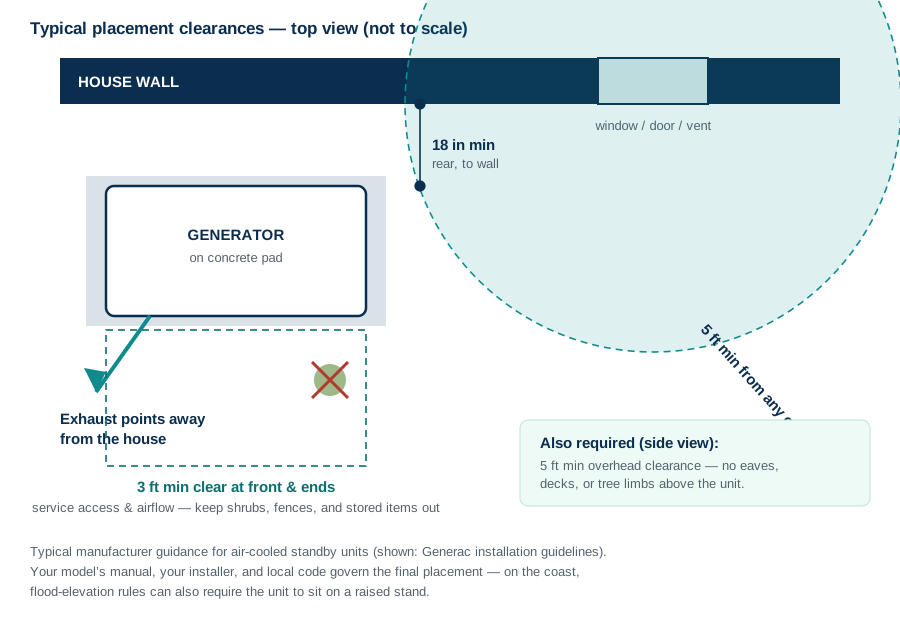
- The openings rule comes first: At least 5 feet from operable windows, doors, vents, and fresh-air intakes — this is the carbon-monoxide rule, and the guidelines give it no exceptions.
- Service space: 18 inches minimum at the rear wall and 3 feet at the front and ends, kept clear of shrubs and fences so the unit can breathe and be serviced.
- Overhead: 5 feet clear above the unit — no eaves, decks, or tree limbs.
- Elevation on the coast: In mapped flood zones, placement also means height: the unit generally must reach the required flood elevation for the lot, which is why many Gulf Shores and Orange Beach installs sit on stands beside elevated homes.
- Permits: Your installer should pull the city building and trade permits (electrical, plus gas where applicable) as part of the job. See the per-city checklists on the Daphne, Foley, Gulf Shores, and Orange Beach pages.
Ongoing Costs
- Maintenance: Standby generators are small engines: oil, filters, plugs, and battery checks on a schedule — typically $300–$500/year through a service plan. Coastal units add corrosion inspection to that list.
- Fuel during outages: A 22kW unit at half load burns roughly 2.5 gallons of propane per hour; natural gas use shows up as a modest bump on your gas bill instead.
- Exercise cycles: The unit runs itself briefly each week to stay ready — a small, normal fuel cost, and the heartbeat your monitoring app reports.
Fuel Use & Runtime, From the Spec Sheet
The averages above come from published numbers. Generac's specification sheet for its 22 kW air-cooled model lists natural gas consumption of about 228 ft³/hr at half load and 327 ft³/hr at full load, and propane at about 2.53 gal/hr at half load and 3.90 gal/hr at full load. For a Baldwin County home on propane, that math decides how many days a tank carries you through a post-storm outage:
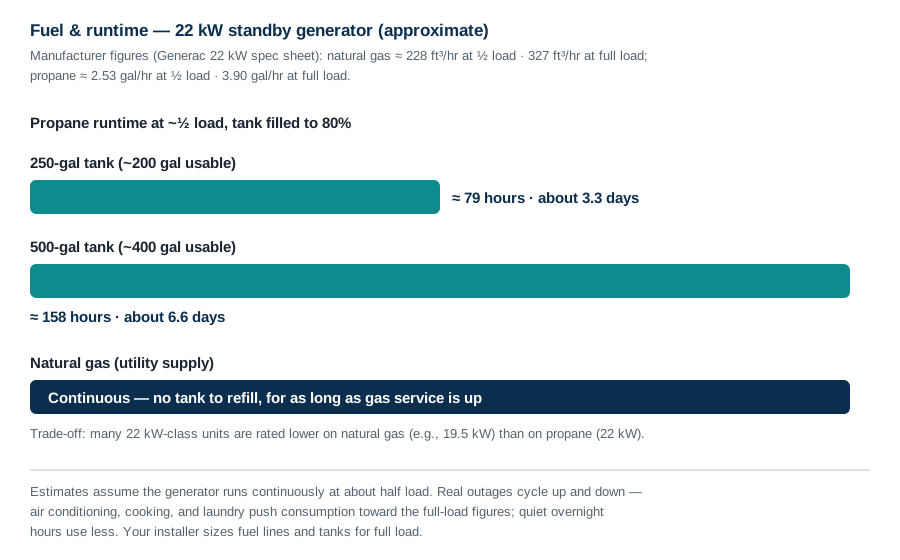
Fuel-consumption source: Generac Guardian Series specification sheet for the 22/19.5 kW model (manufacturer figures; see the references on the sizing calculator page). Other sizes and brands differ — your model's spec sheet is the authority.